
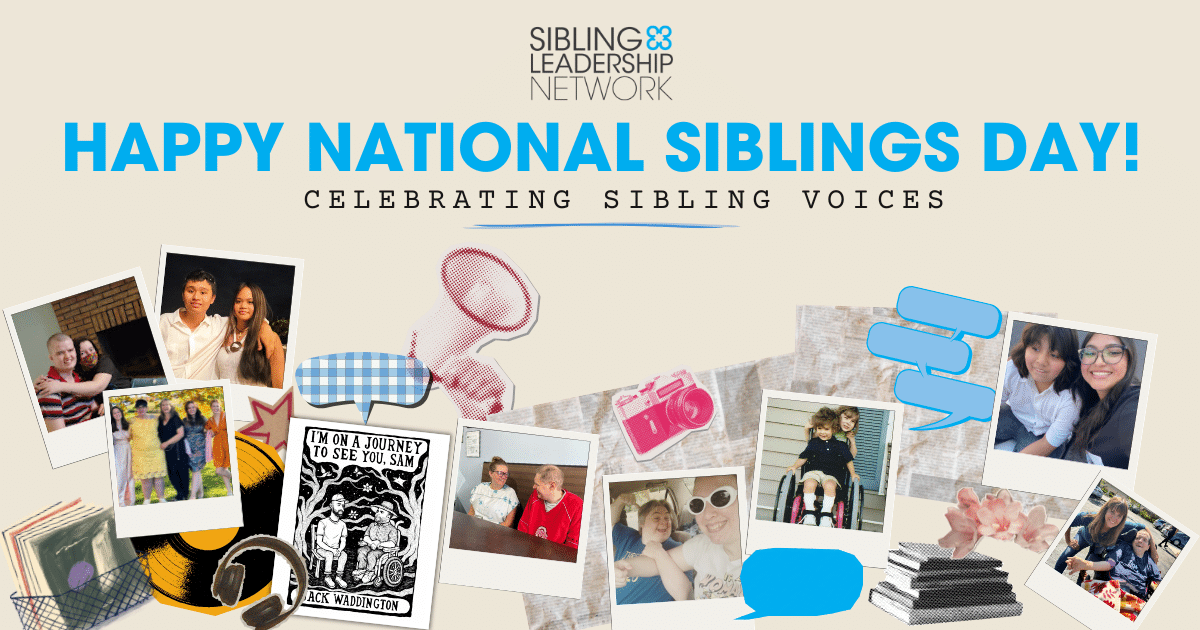
In honor of National Siblings Day, we invited siblings of people with disabilities to share their stories. What came through was a collection of voices that reflect the full range of this experience—joyful, complicated, funny, exhausting, meaningful, and everything in between.
Some shared what being a sibling means to them. Others reflected on small, everyday moments that capture their relationships, or named the things people often misunderstand. Many spoke to what has shaped them, what has been challenging, what brings them joy, and what they wish others better understood about the sibling experience.
We’re deeply grateful to everyone who shared.
”As a younger sib, which is a bit more unusual as far as I’ve seen, it’s been a journey. I was born into this life with my 6 1/2-year-old brother with Down Syndrome. I grew up with complicated thoughts of “why is he getting so much more attention? that’s not fair!”, while at the same time feeling “my parents love me just as much as they do my brother, and they do so much for me.”
As an adult, you come to see your sib in a much more “nuanced” way. Yes, he at times needed more, got more attention, but my parents were doing the best they could considering the times they were raising him in (the late 70’s/early 80’s) and the somewhat limited income they had. We never went without, though. Never felt neglected or “less than”, and I thank my parents for that.
I did go through a phase in young adulthood of “I hate my brother for this, for that, for the other”, but now, into my 40’s, my love for him has just grown all the more. I think now, after time & perspective, I see my brother for the loving, silly, “big man” that he is. Especially now that he’s showing signs of dementia, I feel that loss of him coming even sooner than I could’ve imagined, and it makes me want to, even more, cherish the time I have left with him. Knowing his aging process is shorter than that of a “neurotypical” person, I only want to make him happy, while doing what’s best for him, his health, AND, even more importantly, keeping me sane and well in doing so. As they say, you can’t put the oxygen on the person in your care if you don’t put it on yourself first!
Kathryn McNamara from Worcester, MA
Having a twin brother who will always be a child has shaped my experience. Even though he is nearly 30 years old and has autism spectrum disorder, he has many precious moments that show how he sees innocence in everything and, without a doubt, appreciates the little things.
Camille Block from Southern CA
I grew up in Westlake Village, California, one of the early families to settle there after my father was recruited as a college professor to help launch Pepperdine University’s business division. As the firstborn, my life changed dramatically at age three with the arrival of my brother, Kevin—an otherwise healthy baby who lost oxygen at birth. Over the following months, our family gradually uncovered the full extent of his condition: nonverbal cerebral palsy, and later, quadriplegia. Kevin would never control his movements or his speech. His only means of expression were his contagious smile, deep eye contact, and occasional tears or laughter or nonverbal distinct communicative sounds. When Kevin was three and a half, my parents faced an agonizing decision. On the advice of doctors and trusted friends—and in keeping with what was considered acceptable at the time—they placed him in a home for children with severe cerebral palsy, believing it would give him the best care while allowing them to focus on raising my younger brother and me.
They did the best they could with what they knew. But what I couldn’t have understood then was that Kevin’s life would become my most character-forming emotional imprint—the catalyst for a lifelong journey toward answers and emotional wholeness.
From the outside, my life looked normal. Beneath the surface, there was always an ache—a silent longing for my brother’s life to be fixed—and a heavy, persistent guilt for living such a different reality than he did. As I got older, I grew weary of well-meaning words that rang hollow: Everything happens for a reason. You’re never given more than you can handle. I’m sure he doesn’t know any better—he was born that way. Those words didn’t help. They didn’t make sense to me. Honestly, they made me angry.
My deep sense of justice kept me searching for an antidote to the invisible grief buried inside me.
As a child, I often sat with sadness—listening to melancholy records, plucking out wistful songs on the piano, tearing up over the lyrics to Memories, Time in a Bottle, and Love Story. I remember dancing alone in my garage to Nadia’s Theme as I felt the intensity of emotion in my body. It felt normal to me then. Looking back, I can see how unusual it was for someone so young to seek out such melancholy melodies for comfort. I carried unexplained sadness and a low-grade anger that lingered just below the surface. I seemed to live two lives at once—one on the outside, attending school, playing soccer and tennis, singing in the choir—and another, quietly inside, steeped in guilt, grief, and a helpless anger at the injustice of it all. As the years passed, I stepped more fully into the role of helper and advocate, and eventually became Kevin’s medical conservator—navigating hospital stays, fighting battles on his behalf, and serving as his voice. The emotional rollercoaster of watching him suffer, and then witnessing moments of unexpected joy and hope, stretched and grew me in ways I never anticipated. I pressed into the hard questions instead of avoiding them. I stepped toward him instead of pulling away.
Then, two weeks after my daughter left for college, my mother was suddenly gone—taken by a massive stroke, followed by ten years of progressive dementia at a young age. The grief that followed was unlike anything I’d felt before. It acted as a trigger, transporting me back to the day Kevin was taken away from our home, and I didn’t get a vote. The buried sorrow I had carried from that childhood moment finally surfaced with an overwhelming force, and I felt an urgent need to write—to let out the dormant memories and emotions I had held for decades.
Over ten years later, that writing became a book: Hope for Secondhand Suffering—Tools for the Heart When You Can’t Fix Your Loved One’s Pain. It is the story of the invisible emotions that grow out of an intense love for someone who suffers you cannot fix. It touches on the guilt, the need for advocacy, the importance of community, the search for spiritual truth beyond shallow clichés, and the path I found toward something I can only describe as blooming—a transformed heart walking in living hope, even in the tension of unchanged circumstances. While the book speaks to anyone who loves someone living with disability, chronic illness, or ongoing pain, it lives closest to the heart of a Sib. Because at its core, it is a sister’s story of a very special brother.
Nora Fox Handler from Woodstock, IL
I am one of 8 sibling including three brothers with autism and a sister with Crohn’s disease. Having 4 siblings with disabilities had a huge impact on me, my family and my marriage. Life really changed after our mother passed away and we had to, on an emergency basis, figure out how to support and house our brothers who lived with our mother. This lead me to be one of the founders of S.I.B.S. Supporting Illinois Brothers and Sisters, the Illinois chapter of The Sibling Leadership Network. I also served on multiple boards. I spent so much time on advocacy and policy that is was like an unpaid part time job. Life changed again after losing two of our brothers and a typical sister. This lead me to get involved with a sibling loss group on Facebook. Now that I am 70 years old I am starting to pull back a bit and will soon be down to one board and maybe a few committees. This is a very short version of a very long complicated story. I feel like my story could be a book, a soap opera or a streaming series.
Evelyn G.I. from Las Vegas, NV
My little brother is 10 years old now. He is autistic, non-verbal, and has intellectual disabilities. My mother founded a non-profit organization called “Nuestro Viaje con el Autismo”, (Our journey with Autism). I am the president of it and we have created a community for the Hispanic community, families to find resources, support, hope, and love through workshops and events. Being a sibling has impacted my entire life, it shifted my perspective for the better. While my whole being is passionate to help others I would like to share about the weight that some of us siblings carry. Being a sib is hard some days, and impacts every aspect of our life. Especially our mental health. The future that we have ahead, can feel like alot if we have to possibly become caregivers of our siblings. I want other to know that we too need support, we need rest, encouragment, and hope. My brother has behaviors that can lead to him or those around him to get hurt. Society views him a certain way just because of his crisis, instead of seeing him as an individual who is struggling to communicate his needs. Due to this its an extra weight I carry, and I want the people to understand that we need support in this aspect of our siblings growing older and possibly not becoming independent. Families in general need the support because it is a silent weight we hold all our lives, and I want to advocate for others to recognize this perspective. Some Siblings are caregivers, we need community, support, rest and above all love.
Amelia (me) and Celeste (sister with disabilities) writing from Louisiana
Author’s note: I wrote this during grad (OT) school (October 2024).
She Taught Me Love Without Words: Growing Up Alongside a Sibling with Disabilities
My sister and I are different flowers from the same garden. Together, we’ve grown to make a beautiful bouquet that represents our unique sisterhood impacted by disabilities. I want to describe the bond my sister and I share as well as the experience growing up alongside a sibling with disabilities. This narrative is intended to better understand the feelings commonly experienced by the sibling without disabilities.
I was two years old when my sister, Celeste, was born. To my family’s surprise, Celeste was born with an orthopedic condition that resulted in multiple joint contractures. Though I cannot remember these moments from my early childhood, my parents relayed the mixed feelings they experienced, including shock, joy, worry, hope, and numbness. All I knew was “I’m going to have a little sister” and that’s all that mattered to me. My mother jokes that I tried to be helpful from the moment I met Celeste because I attempted to feed her a banana at a few days old. From that point forward, I proudly proclaimed the title of “Celeste’s sister.”
As months and years passed, it became clear that Celeste may never communicate through spoken words or develop the cognitive and motor skills to live life independently. Celeste received occupational (OT), physical (PT), and speech therapy (ST) services her entire childhood. As her sister, I often accompanied her to appointments, and sometimes her therapists would let me play with Celeste during sessions. I was fortunate to witness the progression Celeste made in her therapy goals and see how it impacted her life at home and in the community.
Therapy taught Celeste how to feed herself with utensils, propel her hot pink wheelchair with light-up casters, and use an augmentative and alternative communication (AAC) device, among other useful skills. With practice and patience, Celeste learned to independently navigate her environment, eat meals, and communicate her preferences. Although Celeste continues to need assistance in all other areas of self-care, including transfers to and from her wheelchair, toileting, dressing, bathing, and grooming, my family and I are grateful for all that she can do.
Reflecting on my childhood and adolescence, my favorite memories involve spending time with Celeste within the community. My family and I were strong advocates for the inclusion of individuals with disabilities and often spent time with local organizations that offered a welcoming environment for Celeste.
Celeste enjoyed playing soccer, basketball, and softball with a local inclusive sports team for individuals with disabilities. I would attend many games to propel Celeste across the field or court with the team to score points or cheer her on from the sidelines.
As Girl Scouts, Celeste and I enjoyed volunteering, camping, as well as selling (and eating) cookies together.
When I was 14 years old, Celeste and I joined Ainsely’s Angels of America, an empowering organization that offers opportunities to celebrate inclusion and unity through community races. Using a specialized racing wheelchair, I pushed my sister over 100 miles and across at least 30 finish lines. Most recently, we completed our first half marathon together. I shed a tear near the end of the race—not because running 13.1 miles is tough, but because every stride is an opportunity to see each other’s life through the other’s shoes, and I am blessed to see the beauty of Celeste’s life.
Celeste spent many summers at the Louisiana Lions Camp, an organization that provides a summer camp experience to children with cognitive and physical disabilities as well as diabetes. Wanting to join the fun, I became a camp counselor. Celeste and I spent a week together away from home and enjoyed activities such as swimming, archery, fishing, paddle boating, as well as arts and crafts. In addition to the memories I made with my sister, I also learned the importance of accessibility, inclusion, and enthusiasm through “LC Love,” as well as met lifelong friends and my husband to-be.
Growing up as a sibling to someone with disabilities led me to experience a vast range of feelings. I reminisce about my happy childhood and recall many wonderful memories spent with my sister, Celeste. However, there were moments when I was conscious of the reality of having a sibling who is dependent on others for living, especially as I grew older. I often harbored my feelings and masked negative emotions, not wanting to display the full truth of how I felt about Celeste. With age, I realized the importance and need to process these feelings to enhance my overall mental and emotional well-being.
To encapsulate these feelings, the following section depicts how I felt growing up alongside a sibling with disabilities:
Hopeful: “Maybe tomorrow she can.”
As a child, each day was filled with hope that Celeste would make progress toward being more independent. As a family, we celebrated each milestone Celeste achieved and hoped she would continue building her motor, cognitive, and language skills. I often prayed that Celeste would miraculously wake up and be able to talk, run, and play alongside me. I dreamed of standing beside Celeste on her wedding day and being an aunt to her children. I live with the hope that my little sister is living a happy life. As an adult, my hopes for Celeste have changed. I now hope she lives a long and healthy life that is free of suffering, I hope that she shares her belly laughs with my future children, and I hope that I will always be around to take care of her…
Responsible: “I know what to do, I’ll help.”
Growing up, I would know exactly what Celeste needed to be taken care of properly. I was able to decipher Celeste’s vocalizations and body language to understand how she was feeling and problem-solve to find a solution to address her needs. I proudly took on the role of “a helper” in my family and was often described as “mature for my age” by other adults. I often saw how tired my parents were from taking care of Celeste and tried to relieve them of their stress by helping with Celeste’s morning or bedtime routines, preparation of meals, and times of wakefulness during the night. My parents and I didn’t realize it at the time, but assuming this significant role led me to experience fatigue and affected my ability to set boundaries for myself.
Independent: “I don’t want my parents to have to worry about me.”
Celeste’s dependent nature led me to crave independence for the sake of not burdening my parents with additional worries. As a child, my outstanding behavior and achievements were influenced by my perceived need to fill a gap in my parents’ lives. However, when I needed help, I hesitated to tell my family and tried to handle my problems on my own. I felt like my needs were not as important as Celeste’s needs and, therefore, didn’t deserve attention. As an adult, I realize this couldn’t be further from the truth.
Jealous: “Why does she get so much more attention?”
As a young child, it was hard to understand why I was not afforded the same amount of attention as my sister. I believed it was unfair that Celeste’s caretaking required most of my parents’ time and attention. There were times I wished I could spend time with my parents, together or individually, without my sister.
Embarrassed: “Why is everyone staring?”
I sometimes felt embarrassed in public settings when Celeste made atypical noises or when she rocked in her wheelchair. I wanted her to act “normal,” which was an unfair and unrealistic standard, to try and fit in with peers. It was common for people in public to stare at Celeste or our family, which felt uncomfortable. I was afraid of Celeste being judged for her differences and became incredibly defensive against people who would mock her.
Guilty: “I feel bad for getting mad because it’s not her fault.”
It’s typical for siblings to have arguments and get into fights. However, I often felt guilty for being frustrated with Celeste. I was irritated when Celeste’s vocalizations were loud and repetitive, when she would run into my legs with her wheelchair, or when she would pull my hair, which were often actions she could not necessarily control. This led me to feel guilty because Celeste could not defend herself against me.
Fearful: “What’s the future going to look like?”
As I grew older, the more I realized how much uncertainty lies within the future. Anxiety festered within me as my mind went down a rabbit hole of thoughts wondering what would happen when my parents were no longer here or able to take care of Celeste. It scared me to imagine that one day I would be solely responsible for the caretaking of my sister. Beginning as a teenager, I found it stressful to consider how my life and future family would be affected by being Celeste’s primary caretaker. Through conversations with my parents about plans for Celeste’s care, these fears are alleviated, but still not completely resolved simply because it’s difficult to predict what the future is going to look like years from now.
Joyful: “You are my best friend.”
I felt genuine joy being Celeste’s big sister. A fun memory I cherish is placing Celeste on top of a blanket on the floor and sliding her around the living room. I loved seeing Celeste smile and hearing her giggles radiate throughout our childhood.
Loving: “I love you for who you are.”
Celeste and I share an unconditional love. Without saying a single word, Celeste taught me love in its most genuine form. Through this love, I learned to accept others’ differences as well as be empathetic and kind to all.
Who I am Today:
I sincerely believe my experience being Celeste’s sister molded me into the person I am today. Celeste motivates me to be courageous and pursue my dreams. I recently graduated with my doctorate in occupational therapy and am now a skilled clinician in a profession I’ve aspired to be in since I was nine years old. I am inspired by Celeste to be a lifelong learner and an advocate for individuals with disabilities.
Celeste has taught me invaluable lessons about humanity and myself. I wonder, who would I be without Celeste? I’ve come to peace with never knowing this answer because of how great life is because of her.
This is my unique experience growing up alongside a sibling with disabilities. Other siblings of those with disabilities may share many of these common feelings in their own way in their own lives. To conclude this narrative, I want to emphasize the importance of addressing the many feelings that live within this special sibling relationship. I encourage siblings of those with disabilities, as well as parents raising both children with and without disabilities, to seek resources to process their feelings. The strongest gardens are those that are well tended to and watered with love.
Jack Waddington from London, UK
Being Sam’s brother shaped pretty much everything about me. Growing up, a lot of it felt normal, because it was our normal. Wheelchairs, care routines, helping out where I could. It wasn’t something I questioned much at the time. It just was what it was. But looking back, I think I was always learning how to read a room, how to adapt, how to be patient. And also how to carry things. Like anticipatory grief. Since he died, I still talk to him. That hasn’t really stopped. It just looks different now. I actually ended up writing a book that started as letters to him, because I didn’t want that conversation to end. If anyone wants to read more about our story, you can find it here: www.jackwaddington.co.uk Being his brother taught me empathy, resilience, and how to sit with uncomfortable feelings without running from them. It also taught me how important it is to just be present with someone. You don’t always need to fix things. Just being there matters.
Yasmeen Hameed-Chan, Singapore
I grew up in the shadow of my brother’s schizophrenia. His symptoms started when he was around 14 and I was 11. I instinctively learned to swallow my feelings and needs in order to not further burden my family; ai became perfectionistic. As an escape, I built The Other World of friends and work where everything was “normal”. Still, I often felt unseen, not understood and isolated. I would often cry privately and go down the rabbit hole of hopelessness and the burden of future caregiving. I was filled with confusing and conflicting emotions. Decades later, I went for therapy and that’s when I learned about childhood emotional neglect and just how much I have been impacted, too, by his illness. It’s not just him and my parents who were there! Since then, I have been advocating for the Sib experience via my writings in my blog, other mental health platforms and the media. I am also active in the Singapore Sib support community. Finally, I am writing a memoir about growing up as the invisible sibling of special needs, and I hope it will be a source of validation and comfort and inspiration to my fellow Glass Children.
Cheryl Albright (sib) & James Albright (sibling)
Nobody asks if you want the job. One day you just have it — sibling to someone with autism and IDD — and you figure it out as you go, mostly through trial and error, occasionally through embarrassing public scenes you’ve learned to narrate like a nature documentary. It’s not the sibling relationship anyone writes greeting cards about, which is fine, because those cards were never going to cut it anyway. What I have learned, slowly and without much grace, is how to stay steady in the middle of the chaos — which, it turns out, is the whole job.
I love my brother very much, but for the most part it can be so tiring and sometimes lonely. For a while, I used to always think how lucky my cousins are to have a sister who’s always there for them and how much of a strong bond they share. Even with my friends, hearing stories about their time with their siblings makes me wish how much I wish I was able to have a strong bond with my brother. I wish I was able to tell him about stuff going on at school, or complain about things, talk to him when I need comfort, but sadly I’m not really able to do that.
As I grow up, a lot of relatives or family friends always say to me along the lines of “Make sure to mind your brother as you grow old” or “You need to work hard so that you can provide for your brother and your parents.” Yes, they are not completely wrong, but it feels like they completely ignore my own future and what I want to do.
Coming home from school to my brother throwing a tantrum or just being loud in general can be so exhausting, as I’m not able to focus on my schoolwork or study for upcoming tests.
Most of the time, when stuff upsets me or just things going on with my life that I’m struggling with, I tend to keep things to myself, as I know it can put weight on my parents, as they are already exhausted and tired from work and coming home to take care of my brother.
Even though I may not have the strongest bond with my brother, I do appreciate him and love him a lot. A lot of times, I gain this type of bond with my closest friends and my cousins.
I wish that more people pay attention to the siblings as much as the sibling with the disability so that they don’t feel unseen or ignored.